

A Developer’s Map of the European Power Grid
The central hub for my series: The European Power Grid for Software Developers

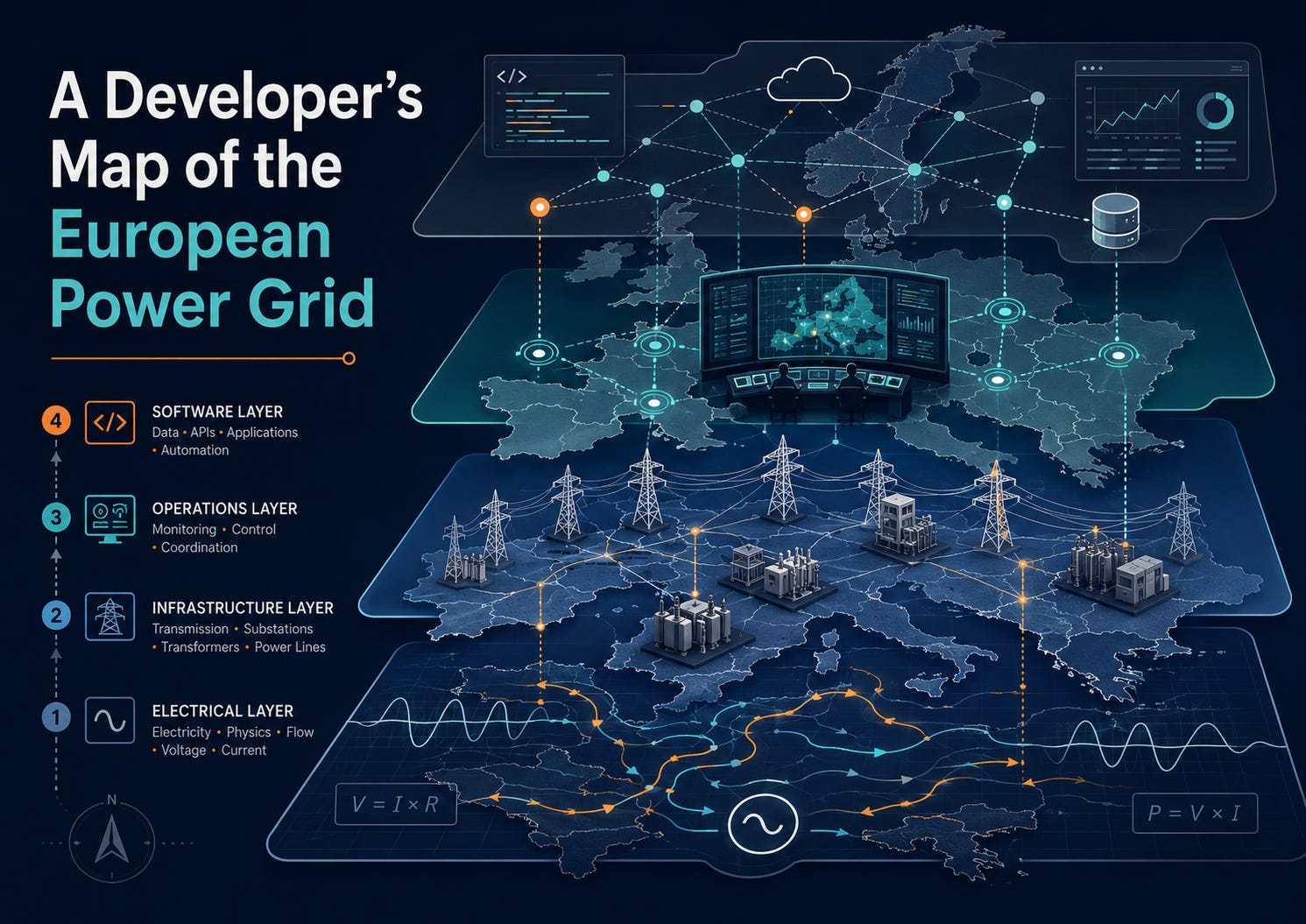
I have spent a lot of time learning technical systems by rebuilding them from first principles.
With TLS, I tried to understand the protocol not by starting from the final polished design, but by beginning with a simple and broken version. Then I added one missing idea after another: encryption, integrity, key exchange, certificates, and identity. Step by step, the real structure started to make more sense.
Now I want to apply a similar mindset to another system, but on a much larger scale: the European power grid.
The grid is not a small topic. It is not only wires, power plants, and substations. It is also physics, real-time operation, markets, regulation, international coordination, forecasting, automation, cybersecurity, and software. It is one of the most critical systems around us, but for many software developers it often remains hidden behind abstract words like “energy sector,” “smart grid,” “TSO,” “DSO,” “balancing,” “SCADA,” or “grid modernization.”
While trying to learn this field, I noticed a recurring problem: many explanations are either too shallow, too regulatory, or too electrical-engineering-heavy. Some give a high-level business overview, but do not explain the physical system underneath. Others focus on laws, institutions, and market rules, but are hard to connect to the actual grid. Electrical engineering resources often go deep into theory, which is valuable, but not always the easiest entry point for software developers who first need a connected map of the whole system.
That is the gap I want to work through.
I want to build a central learning hub where I slowly connect these pieces together.
In this post I will explain what I want to build, why I am building it, and how I want to approach the European power grid from the perspective of a software developer who wants to understand the industry from the ground up.
Why I Am Starting This
My goal is simple: as a software developer, I want to better understand this critical industry and the components it is built from.
This is not a random topic for me. I already work in this industry, and the closer I get to energy systems, grid-related software, and operational technology, the more I see that software is only one layer of a much larger system. To build better software, make better technical decisions, and understand the real problems behind the requirements, I need a clearer picture of the whole grid.
I do not want to look at energy software as isolated applications detached from the physical system underneath. I want to understand what the software is connected to, what constraints the grid has, why those constraints exist, and how the different layers of the industry fit together.
When we build software for ordinary web applications, we can often reason mostly in terms of users, APIs, databases, queues, services, and infrastructure. The physical world still matters, but it is often abstracted away.
The power grid is different.
Software in this industry does not exist in a vacuum. It is connected to physical equipment, operational constraints, safety requirements, regulations, market structures, and cross-border coordination. A wrong assumption is not just a wrong assumption inside an application. It can touch real infrastructure, real operators, real assets, and real consequences.
That makes the field difficult, but also very interesting.
I want to understand the grid not as a collection of disconnected terms, but as one layered system. I want to see how electricity behaves, how the physical infrastructure implements that behavior, how operators keep the system stable, how organizations divide responsibility, how Europe coordinates the whole system, and where software enters the picture.
The Problem With Existing Explanations
When I started looking for good explanations of the European power grid, I often found useful pieces, but not a full map.
Some resources explain the energy sector from a very high level. They describe renewables, transmission, distribution, markets, and policy, but they often stay too far away from the physical system. After reading them, you may know the names of the actors, but still not understand what is actually happening in the grid.
Other resources are very regulatory. They explain institutions, market rules, network codes, responsibilities, tariffs, and legal structures. That is important, but if you do not already understand the physical and operational system, it is hard to know where those rules attach to reality.
Then there are electrical engineering resources, which are often much deeper technically. They explain circuits, machines, power systems, load flow, protection, and control theory. These resources are valuable, but they are not always the right first step for a software developer who wants to build a practical mental model before going deeper into equations and specialist theory.
So the problem is not that the information does not exist.
The problem is that it is fragmented across different worlds.
There is the physics world. There is the electrical engineering world. There is the operator world. There is the regulatory world. There is the market world. There is the software world. Each of them has its own language, assumptions, and priorities.
What I want to build is a bridge between those worlds.
Who This Is For
I am writing this from the perspective of a software developer, but I do not think the topic is useful only for software developers.
Many people enter the energy industry from different angles. Some come from cloud engineering, testing, cybersecurity, data engineering, product management, business analysis, operations, regulation, consulting, or management. Many of them face the same problem: they see parts of the system, but not the whole picture.
Even if my own final focus will be software, I believe that a clearer map of the whole grid can be useful for anyone who wants to understand where their work fits.
If you work on an energy platform, it helps to know what physical process your data represents.
If you work on testing, it helps to know which failures matter operationally.
If you work on cybersecurity, it helps to understand what assets, protocols, and control paths are critical.
If you work in cloud or data, it helps to know why not every problem in this industry can be treated like a normal SaaS problem.
If you work in product or management, it helps to understand the difference between a market requirement, an operational requirement, and a physical constraint.
That is the kind of map I want to build.
Not a complete electrical engineering education.
Not a regulatory encyclopedia.
Not a shallow overview of energy trends.
A practical, layered explanation of the European power grid for people who want to understand the system behind the software, decisions, and infrastructure.
What This Hub Will Become
This page will become the central hub for the series.
I will update it as new articles are published, and over time it should become a structured entry point into the whole topic. The goal is not to explain everything at once. The goal is to build the map piece by piece.
First, electricity itself.
Then the physical grid.
Then operations.
Then management.
Then governance and markets.
Then international coordination.
Then software.
I expect this to take time, and that is fine. Complex systems are not understood in one article. They become understandable when we build the right layers in the right order.
That is what I want to do here.
I want to take the European power grid, one of the most critical systems around us, and make it more understandable from a developer’s point of view.
Not by pretending it is simple.
But by building the mental model step by step, from physics to software, until the grid starts to feel less like a black box and more like a system that can be understood.
All parts of the series:
Electricity Is Not Water: A Better Mental Model for the Grid

Part 1: Electricity Before Infrastructure
Before we talk about energy companies, markets, software, smart meters, substations, or regulation — we need to understand the physical system underneath. The grid is not just a business system for buying and selling energy. It is a large physical machine that must stay stable every second.
The Grid Is Not a Pipeline

Part 2: The structure and components of the grid.
The power grid is often imagined as a large water system. For a software developer, the better mental model is not a pipeline. It is a graph.
Transmission lines are edges. Substations are nodes. Generators, storage systems, distribution grids, industrial consumers, cities, and interconnectors are attached to this graph at different points.
How the European Grid Stays Stable

Part 3: The explanation about how the grid stays stable.
In this post you will learn how protection, monitoring, operation and control work together, what SCADA contributes to that chain, which physical variables operators care about, and what happens from the first instant after a large generator disconnects until the grid reaches a new secure state.
How Europe’s Power System Is Organised

Part 4: The structure of Europe's Power System
The EU electricity sector is not one company moving electricity from power plants to consumers. It is a regulated system of different actors whose responsibilities overlap without becoming identical.

If you are interested in how the European power grid works, from electricity and infrastructure to operations, governance, and software, subscribe to follow the series as it grows.