

Electricity Is Not Water: A Better Mental Model for the Grid
Electricity Before Infrastructure, Part 1 of The European Power Grid for Software Developers

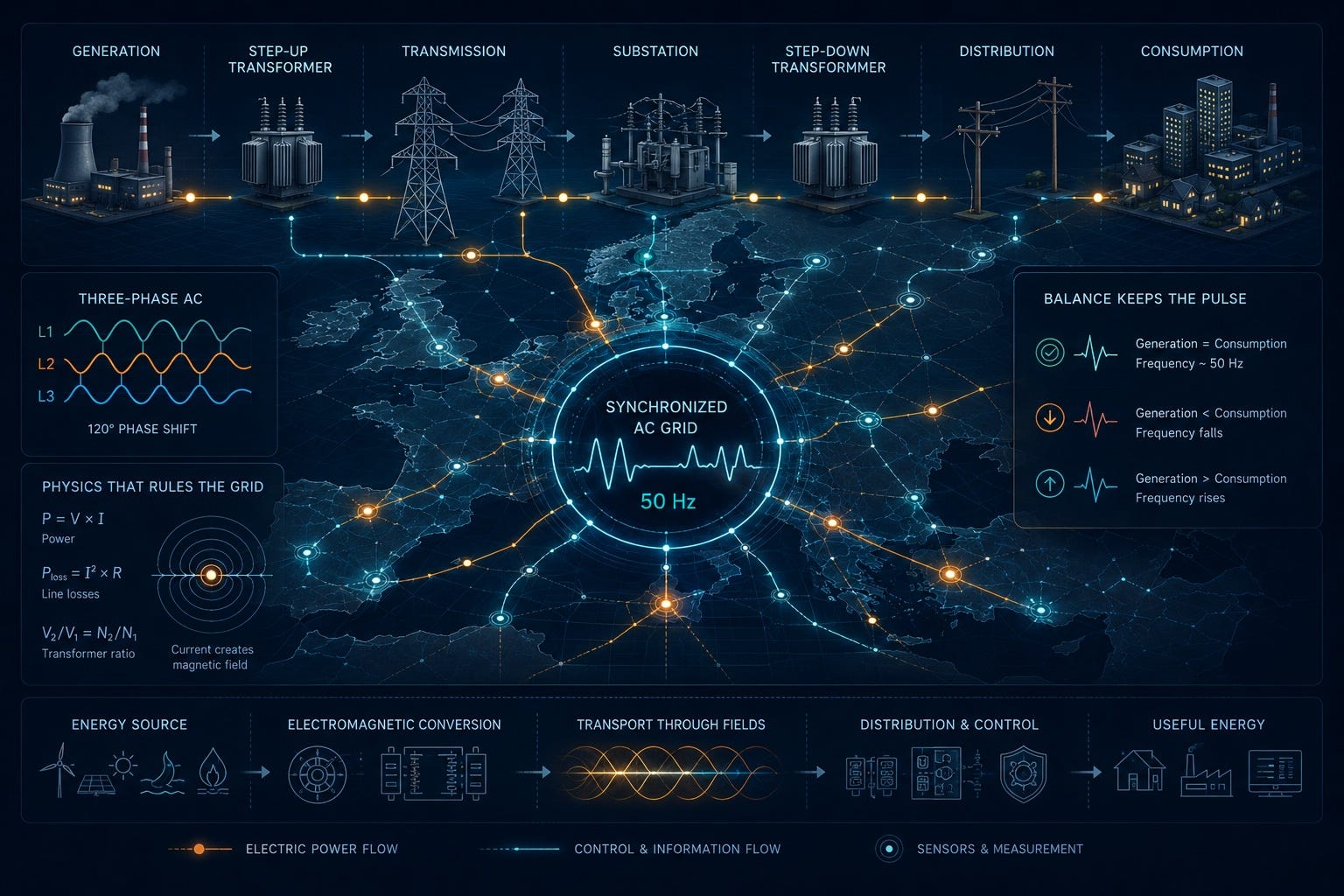
Most requirements in critical industries come from the physical world, and the power grid is no exception. Electricity has rules that cannot be negotiated with. Distance, geography, weather, forests, cities, mountains, sea cables, and even animals shape how the grid must be built and operated.
Before we talk about energy companies, markets, software, smart meters, substations, or regulation — we need to understand the physical system underneath. The grid is not just a business system for buying and selling energy. It is a large physical machine that must stay stable every second.
My approach is simple: deconstruct and rebuild. We start with the smallest useful ideas, understand what problem each one solves, and then follow how they connect into the larger system.
So let’s start with electricity itself.
The Water Analogy Is Too Small
A good analogy can make a complicated subject click. A wrong one can quietly block the whole understanding — for a very long time.
This happened to me with electricity.
The common explanation says that electricity is like water flowing through pipes. Voltage is pressure, current is flow, wires are pipes, and a load is something that uses the flow.
At the beginning, this helps. It gives you a picture for a simple circuit. A battery pushes, current flows, a lamp lights up, a heater becomes warm. Nice.
But later this picture becomes a wall.
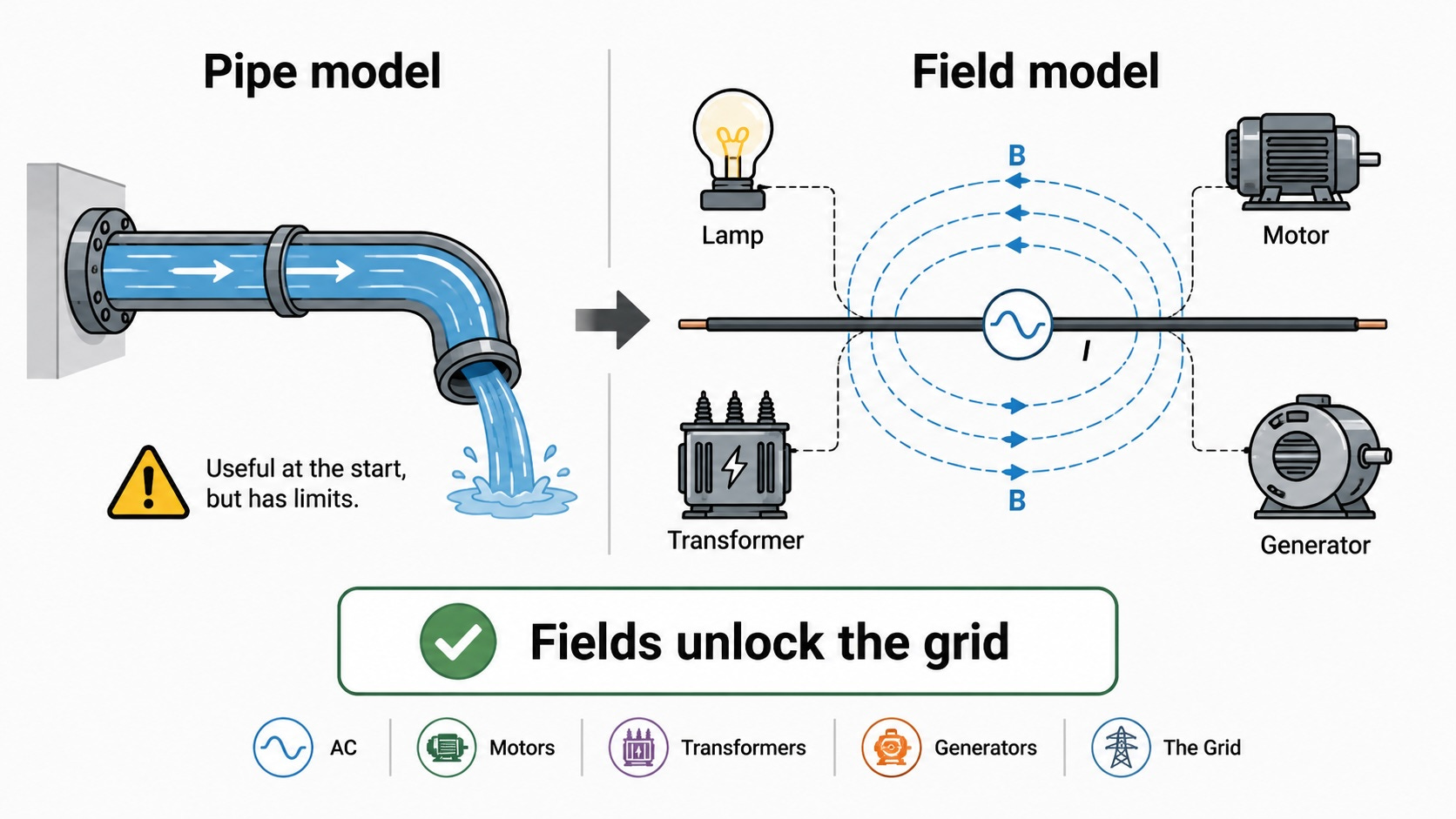
It does not explain motors. It does not explain generators. It does not explain transformers. It does not explain why AC exists, why the grid uses high voltage, why three phases, or why frequency matters so much. And the frustrating part is not that those topics are hard — the frustrating part is that the picture in your head has no room for them. You try to apply the analogy and it just... does not fit. So you feel stupid. But you are not stupid. The analogy is just too small.
Electricity is not only something flowing inside wires. A wire with current is part of an electromagnetic system. Charges move in the conductor, but electric and magnetic fields exist around it — and those fields are not a side detail. They are the reason motors, generators, transformers, AC grids, and frequency make any sense at all.
So: keep the water picture for the first few steps. Then throw it away and build a new one.
The grid is not a pipe system. It is an electromagnetic machine.
And I want to give you a set of analogies that actually maps to this. Not one Swiss Army Knife analogy that is universally bad at everything. A whole zoo of weird, specific, memorable animals — each responsible for one idea, each vivid enough that you cannot forget it.
Let’s go.
Voltage, Current, Power, and Resistance (Where Pipes Still Help)
Here is where the pipe analogy earns its last few minutes on stage.
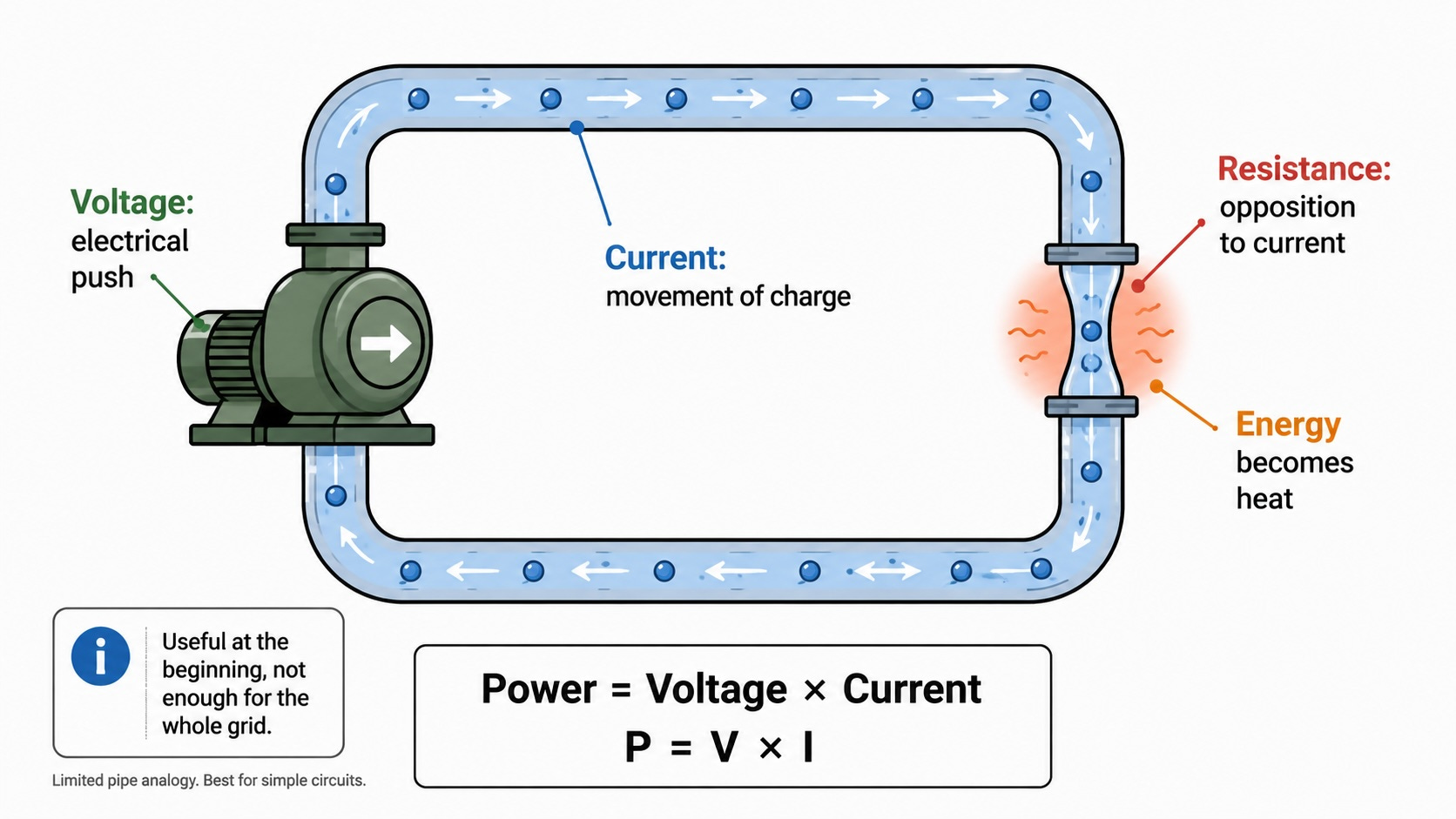
A source creates an electrical push between two points. This push is voltage. When we connect a load and close the circuit, charge can move — and this movement of charge is current.
The load is where energy becomes something useful. Heat in a heater. Light in a lamp. Motion in a motor. Computation in electronics.
Power tells us how much energy is delivered per second:
Power = Voltage × Current P = V × I
This formula matters because power is not only voltage and not only current. It is both together. High voltage with almost no current does not deliver much power. High current with very low voltage also does not necessarily deliver much. Useful electrical power comes from the combination.
Resistance is the opposition a material gives to current. When current flows through resistance, part of the energy becomes heat. In a heater — exactly what we want. In a transmission line — exactly what we do not want.
This already gives us one of the main grid problems: we need to move huge amounts of energy over long distances without turning the wires into giant heaters.
But to understand the solution, we first need the piece that the water analogy keeps hiding.
Current Creates a Magnetic Field (The Piece That Changes Everything)
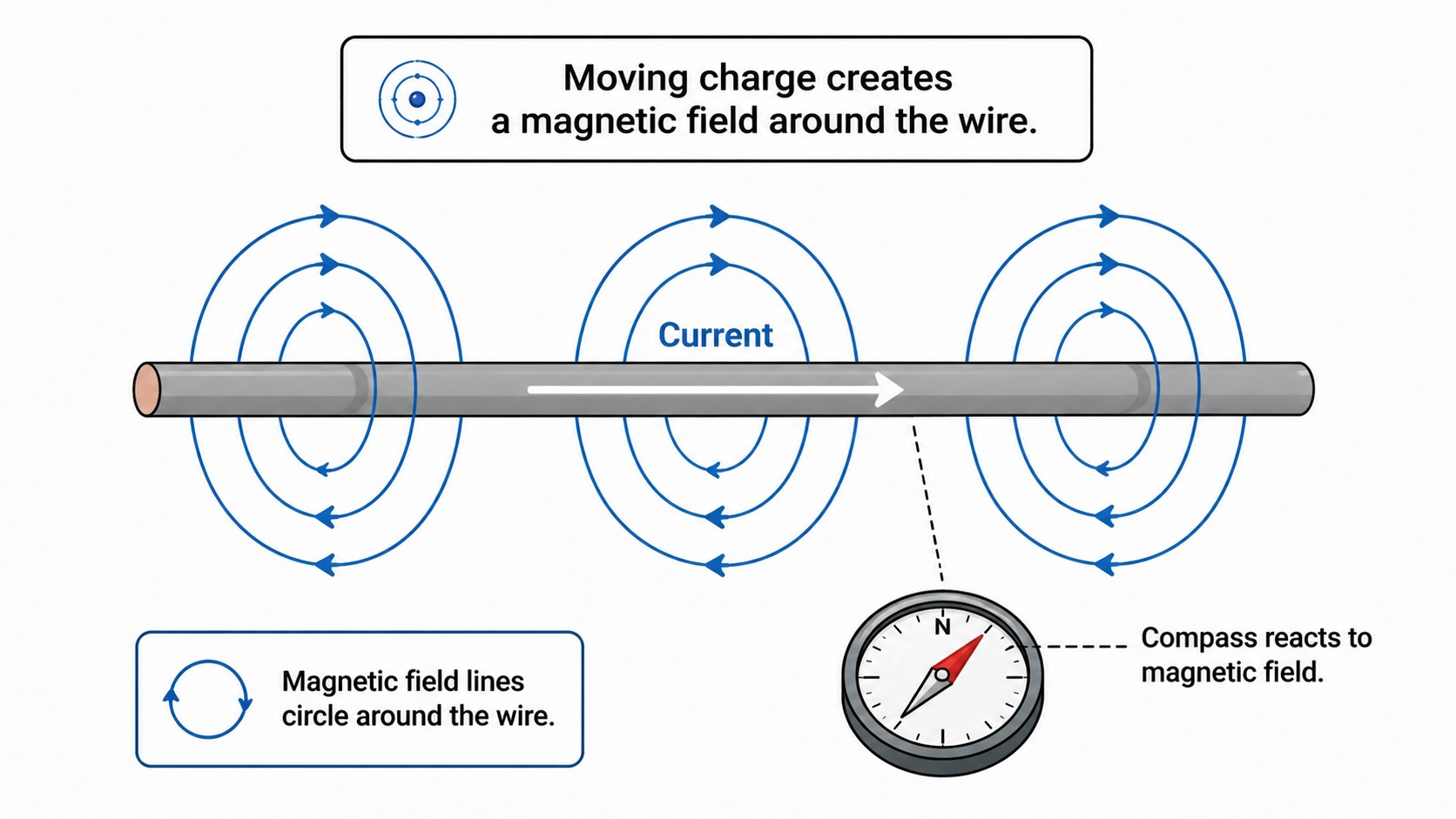
When current flows through a wire, a magnetic field appears around that wire.
Stop here for a second. This is not a small detail. This is the idea that unlocks everything else in the article.
The field is not made from tiny pieces of magnet escaping through the insulation. Electrons are not little magnetic balls flying outward. Nothing leaves the wire.
The idea is stranger and more useful: moving electric charge creates a magnetic field around the path where it moves. That is all. Current flows, field appears around the wire. Stronger current, stronger field. Current changes direction, field changes direction.
A compass near a current-carrying wire reacts — not because anything jumped out of the wire, but because the wire changed the space around it.
This is the moment where the water analogy breaks completely. Water flowing through a pipe stays inside the pipe. Current in a wire creates an effect outside. Electricity can influence the world without electrons leaving the conductor.
This is the bridge to motors, generators, and transformers. Everything from here is built on top of this one idea.
Motors and Generators Are the Same Story — In Two Directions
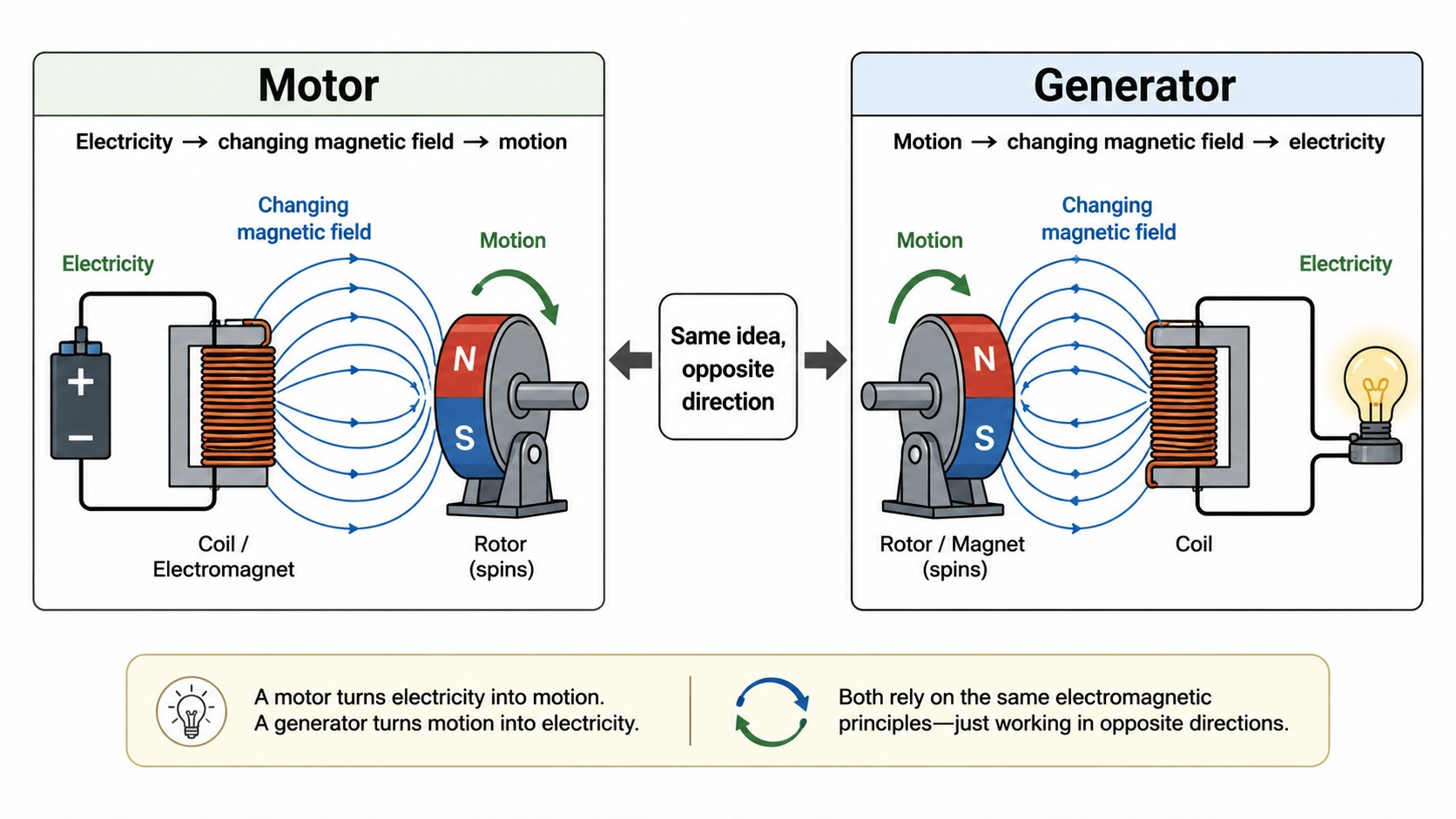
A motor does not work because electrons hit a wheel the way water hits a turbine.
A motor works because magnetic fields push and pull on each other.
Imagine a coil of wire. When current flows through it, the coil behaves like an electromagnet. Place it near another magnetic field, and forces appear. Those forces can create torque. Torque can rotate something.
But here is the problem: one fixed magnetic push is not enough for continuous rotation. If the field stays the same, the rotor moves until it reaches a comfortable position — and then it stops. The same force that helped it move now holds it there. Like a magnet stuck to your fridge door.
So the trick is not only to create a magnetic field. The trick is to keep changing it at the right moment.
Change the direction of current — the field changes direction too. Now the force continues to pull and push the rotor forward instead of letting it settle. Control the timing well enough and you get smooth, continuous rotation.
This is the basic idea behind electric motors: controlled current → controlled magnetic fields → motion.
A generator is the same story in the opposite direction.
In a motor, electricity creates motion. In a generator, motion creates electricity. Move a magnet near a coil, or move a coil through a magnetic field — the magnetic field through the coil changes. A changing magnetic field creates an electric field in the conductor, and that electric field pushes charges. The result is voltage.
A generator does not pour electrical liquid into a wire. It creates voltage because motion changes magnetic fields.
And because large generators rotate, the voltage they create naturally rises, falls, crosses zero, reverses direction, and repeats. Which brings us to AC.
AC Is Not Useless Back-and-Forth Movement
DC means direct current. The push keeps the same direction. A battery is the simplest example.
AC means alternating current. The voltage rises, falls, crosses zero, reverses, rises in the opposite direction, and repeats. In Europe, the grid does this 50 times per second — 50 Hz.
At first, AC feels wrong. If current goes one way and then back again, how does it deliver energy? Doesn’t it cancel itself?
The water picture misleads us here again.
Think of a saw. It moves back and forth, but it cuts wood. A bow drill moves back and forth, but it creates enough heat to start a fire. The motion does not need to travel forever in one direction to do work. The change itself is what does the job.
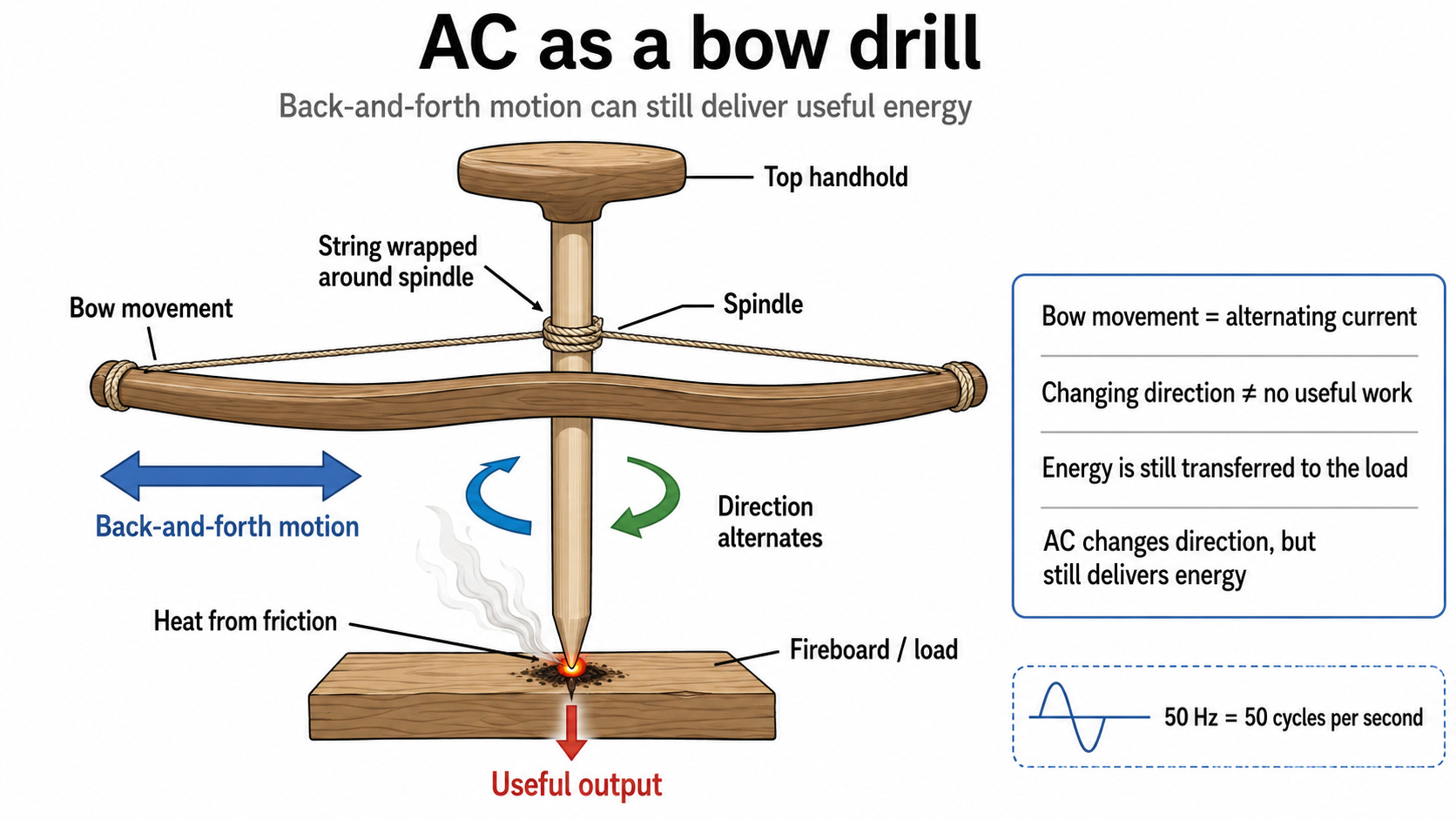
In AC systems, charges mostly move back and forth locally. The electromagnetic field transfers energy through the system, and loads take energy from that field. Electrons do not need to travel from a power plant to your laptop. The field moves through the system, and energy moves with it.
AC is useful precisely because it keeps changing. Changing fields are created naturally by rotating generators. Changing fields drive motors. And changing fields make transformers possible — which turns out to be the key to building any large-scale grid.
High Voltage and Transformers Solve the Distance Problem
Now we can come back to the problem we parked earlier: moving energy far without losing most of it as heat.
The wire between a generator and a city has resistance. Current flowing through resistance turns energy into heat. The formula is:
Line losses = Current² × Resistance P_loss = I² × R
That square is the dangerous part. If current doubles, losses become four times larger. If current becomes ten times larger, losses become one hundred times larger.
Current is expensive. It heats wires, wastes energy, and forces us to build thicker, heavier, and more costly infrastructure.
But power is voltage multiplied by current. For the same amount of power, we can choose different combinations: lower voltage and higher current, or higher voltage and lower current. For long distances, the second option wins easily.
Raise the voltage. Lower the current. Reduce the losses.
This is why high-voltage transmission lines exist. Not because engineers love dangerous numbers. It is because without high voltage, long-distance transmission is just a very expensive heater.
But high voltage that is useful for transmission is not something you want coming out of a wall socket. So the grid needs a machine that can raise voltage before the long journey, and lower it again at the destination.
This machine is the transformer.
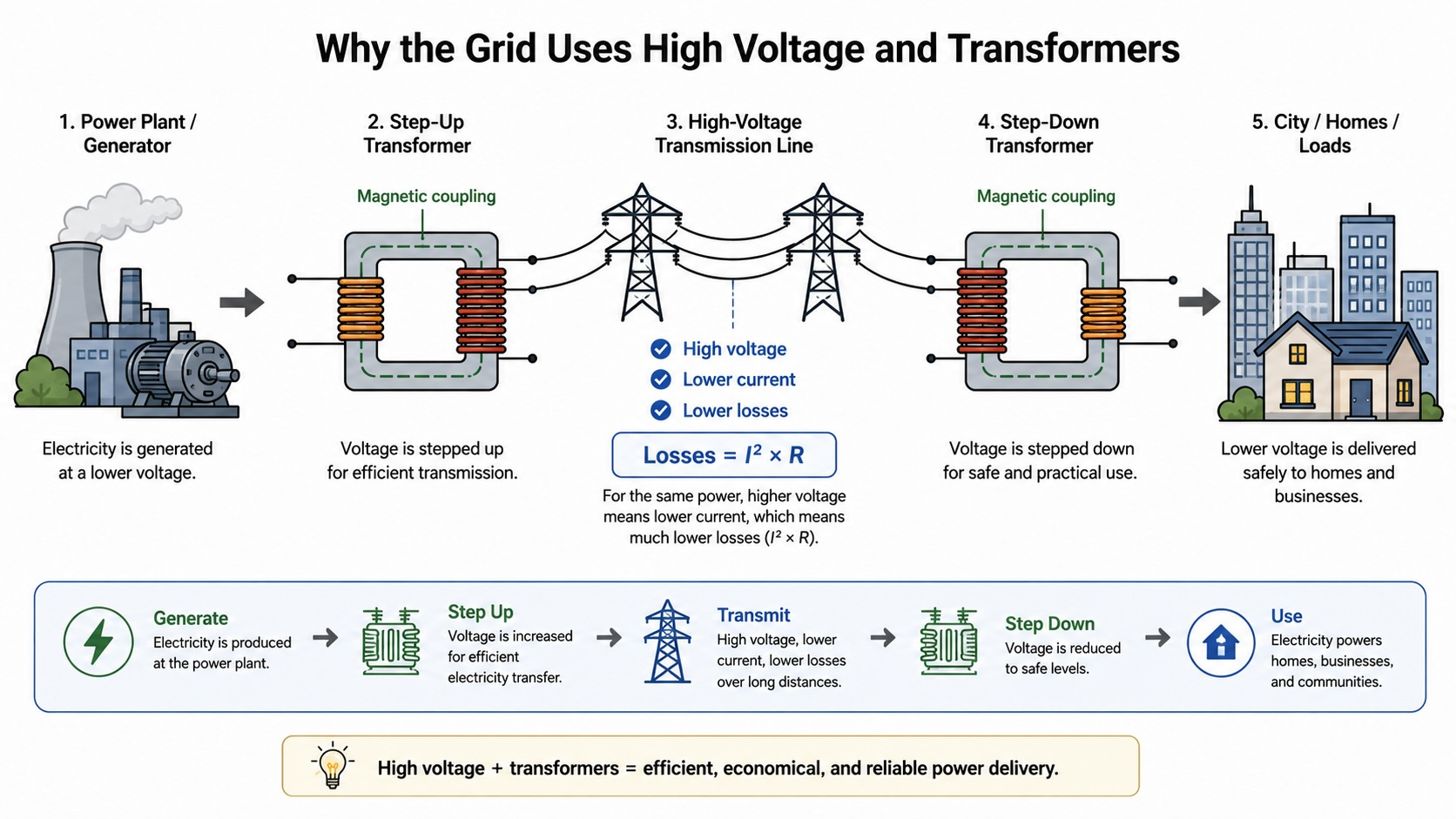
A transformer has two coils wrapped around a magnetic core. One coil is connected to one circuit, the other to another circuit. The two coils are not directly connected by a wire. Electrons do not flow from the first coil into the second.
And still, energy moves across.
With the water analogy, this looks like magic. With fields, it becomes completely clear:
AC in the first coil
→ changing magnetic field in the core
→ changing field reaches the second coil
→ voltage is induced in the second coil
→ power is delivered to the load
The field connects the two circuits.
This also explains why a normal transformer needs AC. Connect steady DC to the first coil and there is only one brief moment — when the current starts — where the field changes. After that, the field becomes steady. A steady magnetic field does not continuously induce voltage in the second coil. No change, no transformer action.
The transformer can also change the voltage level because the two coils can have different numbers of turns:
V_secondary / V_primary ≈ N_secondary / N_primary
More turns on the second coil — voltage steps up. Fewer turns — voltage steps down.
Now the skeleton of the grid is visible. Generators produce power. Step-up transformers raise the voltage. High-voltage lines carry it over long distances. Substations connect, protect, switch, and transform. Step-down transformers bring voltage back down. Distribution networks bring electricity closer to consumers. Loads turn energy into heat, light, motion, or computation.
But there is still one physical improvement missing.
Why the Grid Uses Three Phases
We have AC, transformers, and high-voltage transmission — but one important piece is still not quite right for large-scale use.
Remember the motor problem: we do not only want a magnetic field. We want a magnetic field that keeps the rotor moving smoothly. With a single AC wave, the push changes, weakens, crosses zero, reverses, comes back. It works, but the motor has to fight through those weak and zero points in every cycle.
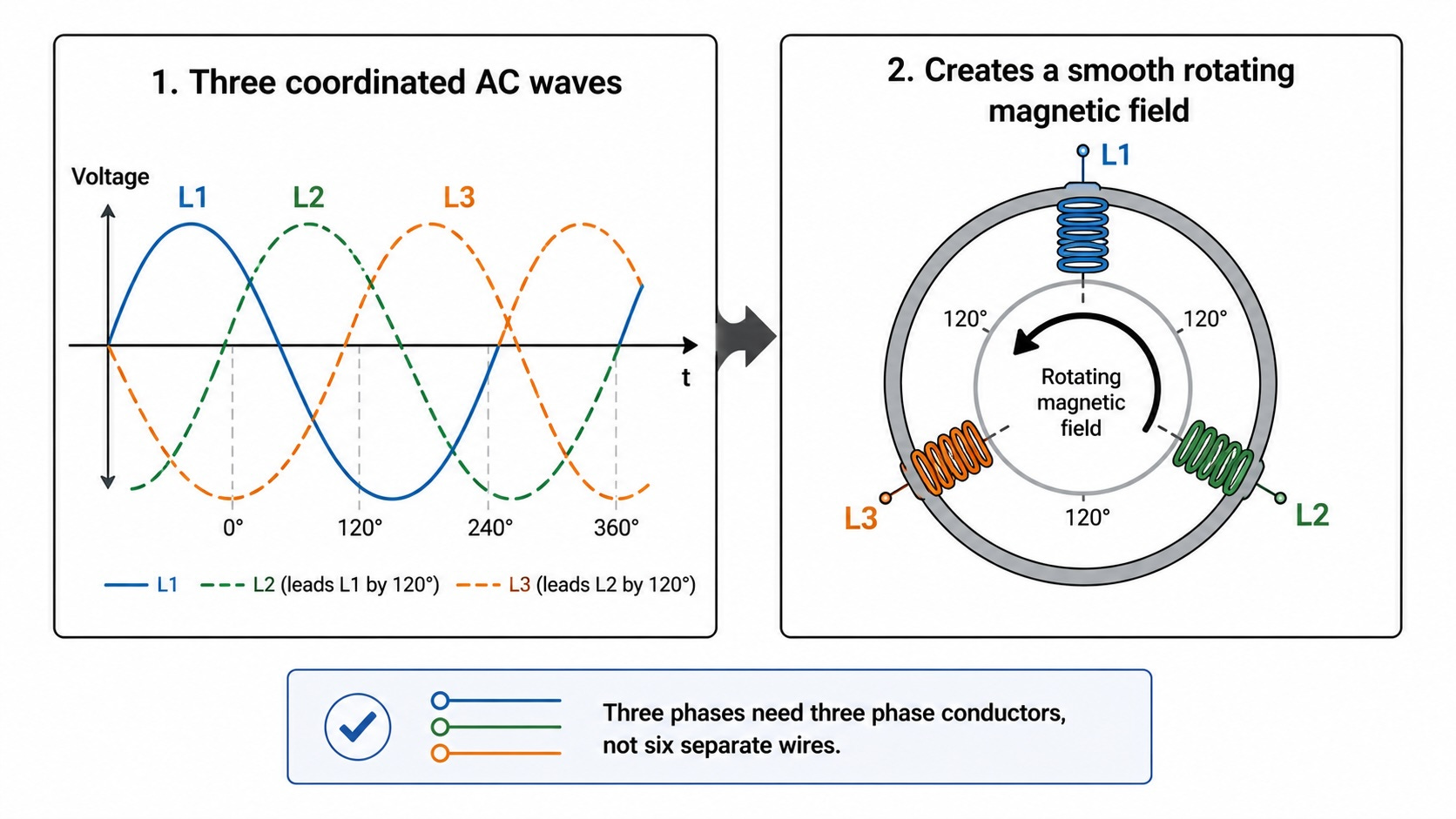
The better idea: use three AC waves instead of one. Not three random waves — three coordinated waves, shifted in time relative to each other. When one phase is near its maximum, the others are at different points in the cycle. When one weakens, another is already growing stronger. Together, they fill in each other’s gaps and create a much smoother delivery of power.
For motors, this is especially valuable because three coordinated phases can create a naturally rotating magnetic field. Not a push that has to fight through weak spots — a field that smoothly turns around the motor and pulls the rotor with it. This is almost exactly what a motor wants.
Now, the elegant part: we do not need six wires to run three separate circuits.
Each phase needs one conductor — so we have three phase conductors: L1, L2, and L3. In a balanced system, the currents in these three phases are shifted so that their sum is zero at every moment. Because of that, the return current cancels out, and a separate return wire is not needed for high-voltage transmission.
This is why you often see three main conductors on transmission towers — not three complete circuits with six wires, but one coordinated three-phase system using three.
Three phases are not an arbitrary complication. They solve a physical problem: smoother power delivery, better conditions for motors, and more efficient large-scale transmission with fewer conductors.
Frequency Is the Pulse of the Grid
Now we have generators, AC, transformers, high voltage, and three phases. The physical machine is assembled.
But the grid is not a tank where you can pour electricity in and take it out freely whenever you want. There is some stored energy in rotating machines, magnetic fields, batteries, and other devices — but the AC grid itself must be balanced continuously. Continuously.
Every second, generation and consumption need to stay close to each other.
If consumers take more power than generators provide, the system starts to slow down. If generation exceeds consumption, the system starts to speed up. And this shows up in one very visible number: frequency.
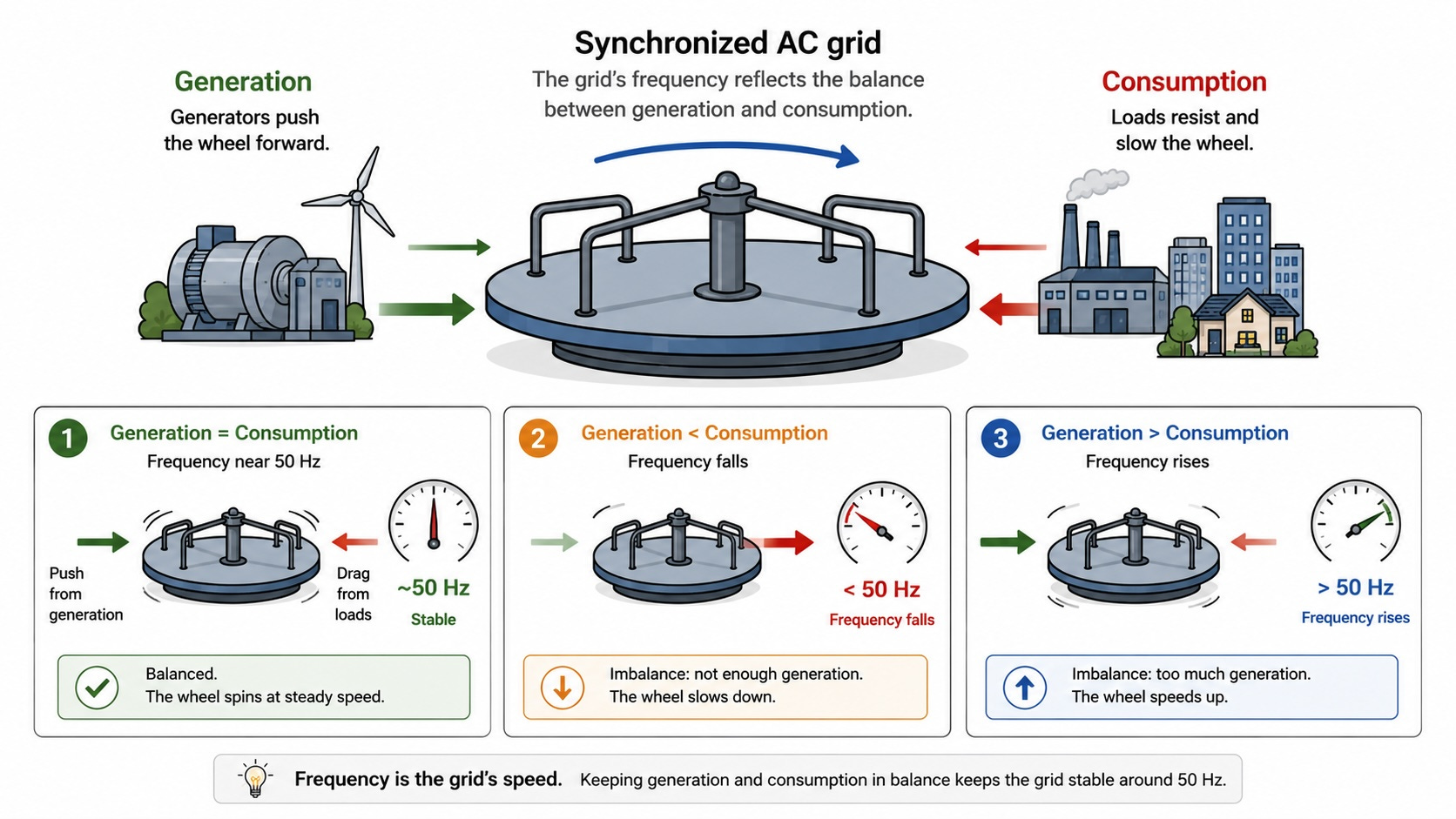
In Europe, the grid runs at 50 Hz. That means the AC waveform completes 50 full cycles every second. When generation and consumption are balanced, frequency stays close to 50 Hz. If consumption exceeds generation, frequency falls. If generation exceeds consumption, frequency rises.
Frequency is not just a number in a technical standard. It is one of the signs that shows the balance of the whole synchronized machine. It is the pulse of the grid.
And this is where the power grid becomes very different from most software systems. In software, we can queue work, buffer messages, retry requests, scale components, and hide temporary imbalance behind storage. The grid has controls and buffers too — but the physical system still has to obey the immediate relationship between generation, load, voltage, current, phase, and frequency. You cannot queue it. You cannot retry it.
The grid is an electromagnetic machine spread over a continent, and that machine must stay inside its limits. If the pulse is stable, the system is alive and balanced. If the pulse drifts too far, something is wrong.
That is the grid’s arrhythmia.
And you have to heal it!
What We Have Now And What Is Next
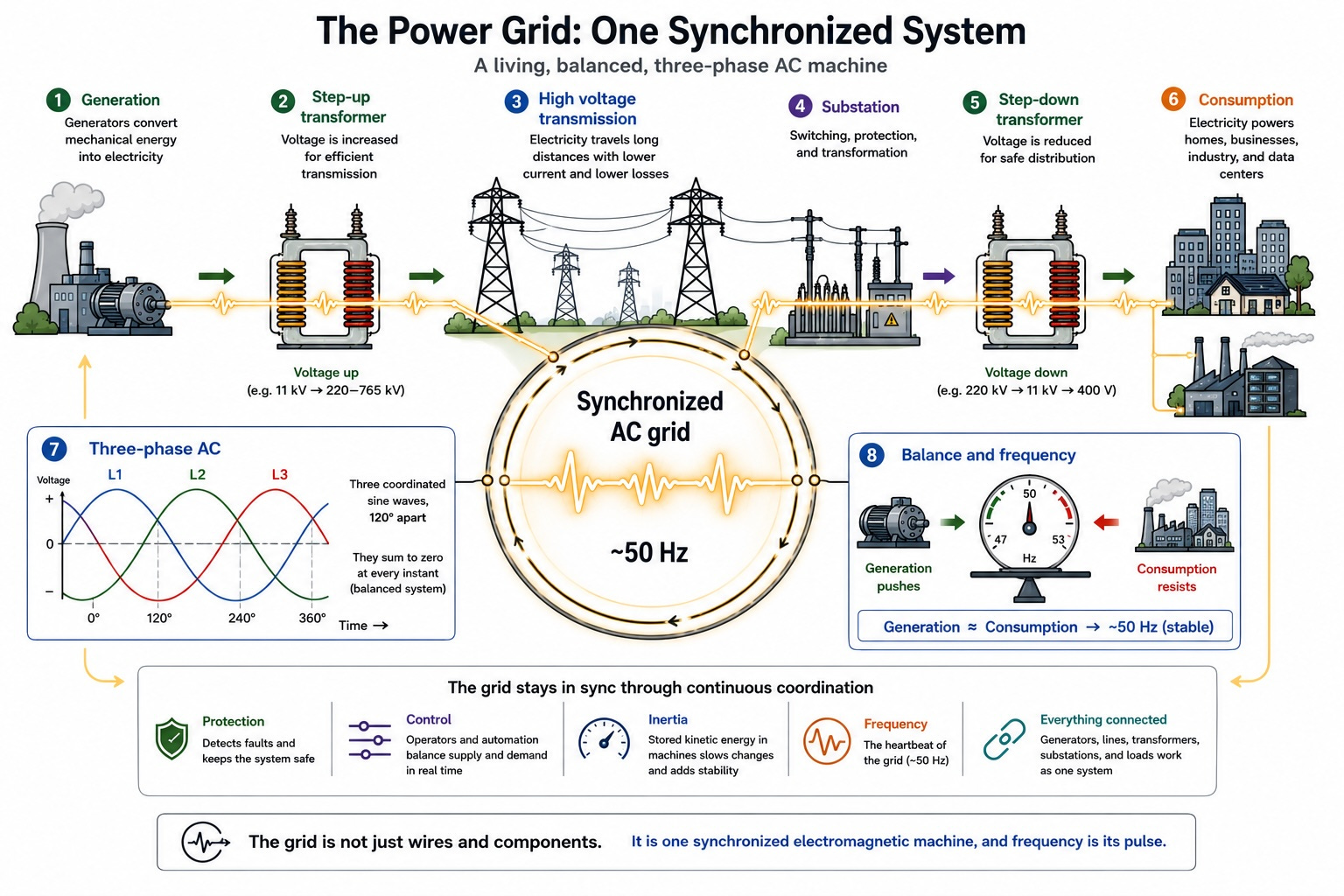
We started with the water analogy because it helps in the beginning. It explains voltage, current, resistance, power, and simple circuits.
But then it breaks.
It cannot explain how electricity creates motion outside a wire. For that, we need fields.
Current creates magnetic fields. Magnetic fields push and pull. Controlled magnetic fields create motion — motors. Reverse the story: motion changes magnetic fields, changing fields create voltage — generators.
Then AC stops being strange. It is not useless back-and-forth. It is repeated change, and changing fields are exactly what generators, motors, and transformers need.
Then distance creates the next problem. To move power far away, we reduce current and increase voltage. Because high voltage is not useful everywhere, we use transformers to step it up and back down.
Then three phases make the system smoother — better for motors, smoother power delivery, efficient transmission without six wires for three circuits.
And finally, frequency shows us that the grid is not a passive network of wires. It is a synchronized machine that must stay balanced every second.
The water analogy was not completely wrong. It was just too small. It helped me enter the first room, and then it locked all the next doors.
The field-based model opens them.
It does not make the grid simple, because the grid is not simple. But it makes the complexity connected. Motors, generators, transformers, AC, high voltage, three phases, and frequency stop being random technical vocabulary and become parts of the same engineering story.
In the next part, we can move from physics to structure: power plants, substations, transmission lines, distribution networks, and the full path from generation to consumption.

If you want to follow this rebuild, subscribe and the next part will find you when it is ready.